

 Basket (
 Main Menu


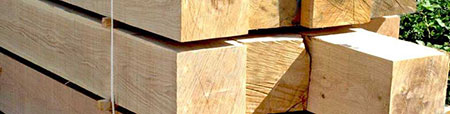
European Oak Beams For Structural Use
- Sourced from sustainable, well-managed forests (PEFC & FSC certified)
- Instant online pricing for custom-cut European Oak
- Expert technical support from our dedicated timber specialists
- Structural grades available including QP1 (D24) and QPA (D30) - Professionally graded to BS EN 14081 standards.
Build Your Cutting List
Related Products
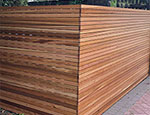
European Oak Beams to buy on line
Oak beams are one of our favourite products. Steeped in tradition, this glorious timber has many uses in a structural sense. So, what are my different options when buying? What are the main characteristics of this fine material? Why should you use Oak over other alternatives?
Below we answer the most pressing questions and offer comprehensive guidance to make sure you get the right beams for you!
Available European Oak Grades & Selection Guide
A grade of timber is how each particular piece is categorised to make sure you get exactly what you are paying for. Each grade allows for a certain standard and when purchasing for construction it is particulary important to pay attention to what you are buying.
iWood supplies 2 "Fresh Sawn" or "Green Oak" grades and an "Air Dried" grade. Our Fresh Sawn QPA and QP1 grades are the most popular and ordered regularly for construction jobs. So what can you expect to see in each grade?
QPA Fresh Sawn Constructional (D30)
This is the top grade of fresh sawn oak, there will be knots in the timber with the possibility of a small amount of wane. All knots should be sound and there should be no holes, end shakes, ring shake, star shake, bark pocket, brown pith, brown streak or rot, bark pocket, brown pith, brown streak or rot (please note, this grade replaces D40, if that's what you're looking for).
QP1 Fresh Sawn Constrcutional (D24)
QP1 is similar to QPA grade however a larger amount of wane is allowed within the grade along with brown streak, black holes and brown pith.
Air Dried Constructional Grade (EX QP1)
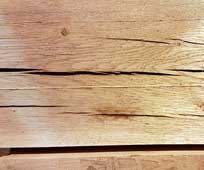
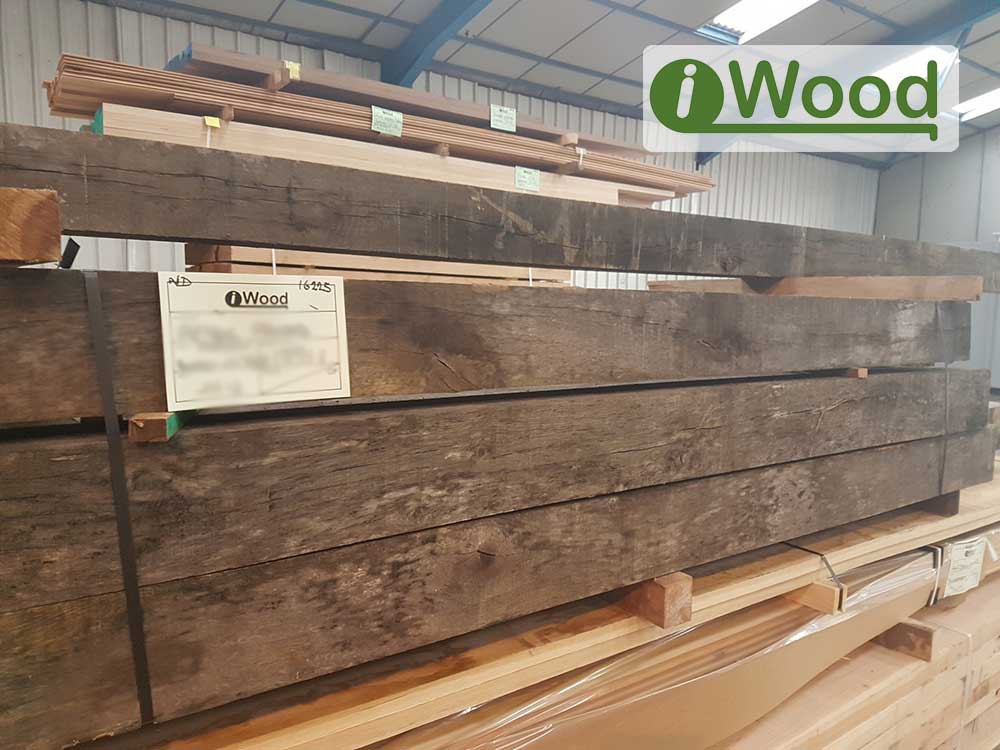
Suitable for construction where reduced movement or an existing aged look is required. Air dried oak has dried naturally for 1 - 3 years, giving the timber a discoloured, darker, weathered look, featuring the highly-sought-after traditional surface checking. It's common practice to hand plane, sand or shot-blast the faces before use, or choose the option for us to plane them for you. Air dried beams, because they already feature splits and surface checking, are often used in restoration work or like-for-like repairs to more closely match existing, aged oak.
| Feature | QPA Grade (Superior) | QP1 Grade (High Quality) | Air Dried Structural Grade |
|---|---|---|---|
| Strength Class | D30 (Higher Loads) | D24 (Structural Standard) | Grade varies by seasoning (Ex QP1 when originally cut) |
| Visual Appearance | Some sound knots and little wane, no pith, clean finish. | Natural character, regular sound knots, some wane. | Aged, weathered look with silvering and splits. |
| Movement | High (Shrinks/shakes as it dries). | High (Shrinks/shakes as it dries). | Low-Medium (Pre-shrunk for 1-3 years). |
| Best Use Case | Heavy constructional work or when visual appearance is highly important. | General timber framing & gazebos. | Restoration & internal work where the least amount of movement is needed. |
| Planing Recommended? | No, sawn is fine if you are OK working with center lines | No, sawn is fine if you are OK working with center lines | Yes, planing reveals the fresh face of the timber, squares the beam up and shows the character of the wood where is has started to move. |
Swipe left/right to compare grades
What is the difference between a sawn and planed finish?
The importance of choosing between sawn and planed is vastly different depending on the grade of structural oak beam you are looking to buy.
Choosing a finish fresh sawn grades (QPA and QP1)
With Fresh Sawn Oak, the main benefits you get with planing are:
- The accuracy in size
- The beams get squared up making them easier to work with if you are not used to working with centre lines
- Any saw marks are removed
So why would you choose sawn beams over planed? If you are used to working Oak, the natural curved edges can be made into a feature of your project and by using centre lines you don't need each piece to be perfectly square. Any saw marks can be removed by sanding the pieces, which is something you may do anyway, even if they are planed. You see with Fresh Sawn Oak, even a planed beam will fir up on the surface due to the moisture in the wood so it may not be smooth when you place a hand over it.
Choosing an air dried beam finish
It's when using Air Dried Oak that we highly recommend getting your timber planed. The differences between a planed and sawn air dried piece are astronomical, the reason for this is down to how Oak is stored when left to air dry. The beams are left outside for 1-3 years where they are left to naturally age over time, naturally this aging makes the beam shrink and contract causing splits to run accross the surface. Another effect is that the timber silver greys as it is exposed to sunlight.
This is where planing comes in, pleaning the beam removes the greyed (and sometimes blackened) faces leaving them looking fresh again, with characteristic patterns accross the face where the surface splits had been. This brings back the beautiful golden colour the beam used to be, which is what a lot of people expect to see.
Sawn Air Dried Beams do see use, and some people prefer to have the darkended faces and to see the cracks and splits in the wood that have already occured. If a beam has been resawn to size you may still see fresh faces on one or two sides so you can get a nice contrast on the beam, if you like that kind of finish.
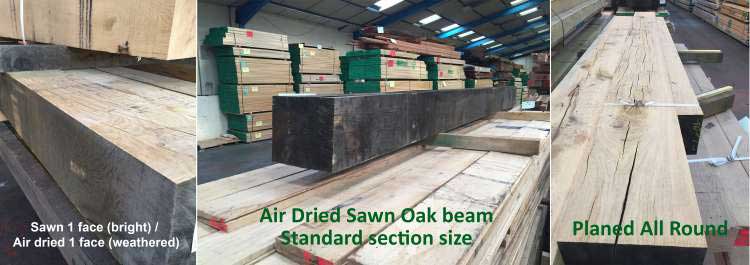
For those not used to using Air Dried Oak, the below image shows the differences between a piece that hasn't been sawn or planed, to a piece that has been planed all round.
Comparing Oak to other building materials like steel
A lot of construction is carried out using man made materials like steel, with more traditional materials (Oak in this case) seemingly being left behind. It's easy to see why, these materials are easier to get hold of and they can span much larger dimensions. Cover them with an Oak RSJ and they suddenly look good too. So why would you choose Oak? What makes it so special?
To start with, Oak (as with all timbers) is a renewable material, harvesting it is kinder to the environment than creating any metal and the sustainable forests we buy from make sure that supplies are well managed to secure its long term future.
Oak is also as naturally strong as it is beautiful, capable of supporting heavy loads in the greatest of buildings. Take a look at the Notre Dame which is currently being rebuilt to it's former glory. The rebuild has taken vast quantities of Oak from French mills with all suppliers playing their part.
You should be wondering about any fire risks involved as well, and you'd be forgiven for thinking that this is where steel would hold an advantage. However, that is not always the case. Whilst metal won't burn like timber, it does have a melting point, so in the unfortunate event of a fire where temperatures get to high the structure fails.
This is where Oak (and other constructional timbers) have the edge, in the centre of the oldest air dried beam there will still be as much moisture as there is wood, which helps to protect the oak from heat and flames. While the surface (which will have dried out) chars the middle can hold itself and maintain a reasonable structural strength, stopping the building from collapsing for some time. An example of this would be the fire that destroyed York Minster, where firefighters had to make a conscience decision to collapse the wooden roof on purpose to help extinguish the fire.
Frequently Asked Questions
These are some of the most frequently asked questions we receive.
Should oak beams crack?
In a nutshell, yes, they should. These cracks are one of the main oak characteristics. Fresh Sawn Oak has a high moisture content so is subject to splitting and cracking as it dries out. This process occurs because the timber shrinks along the width and thickness.
If you aren’t used to working with fresh sawn oak, the changes it goes through can be quite alarming. However, it is important to remember that the timber remains structurally sound during these changes, and it is perfectly natural for it to change.
How long will untreated oak last outside?
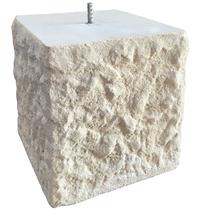
Fresh sawn oak can last 30-40 years when left untreated and when not in contact with the ground, it can last even longer. When left in constant contact with the earth, Oak will decay quicker than if it is set in concrete or raised off the floor. This is why we recommend metal shoes, staddle stones, or concreting the posts into ground on our Gazebos and Pergolas.
My beams have Blue Stain is this something to worry about?
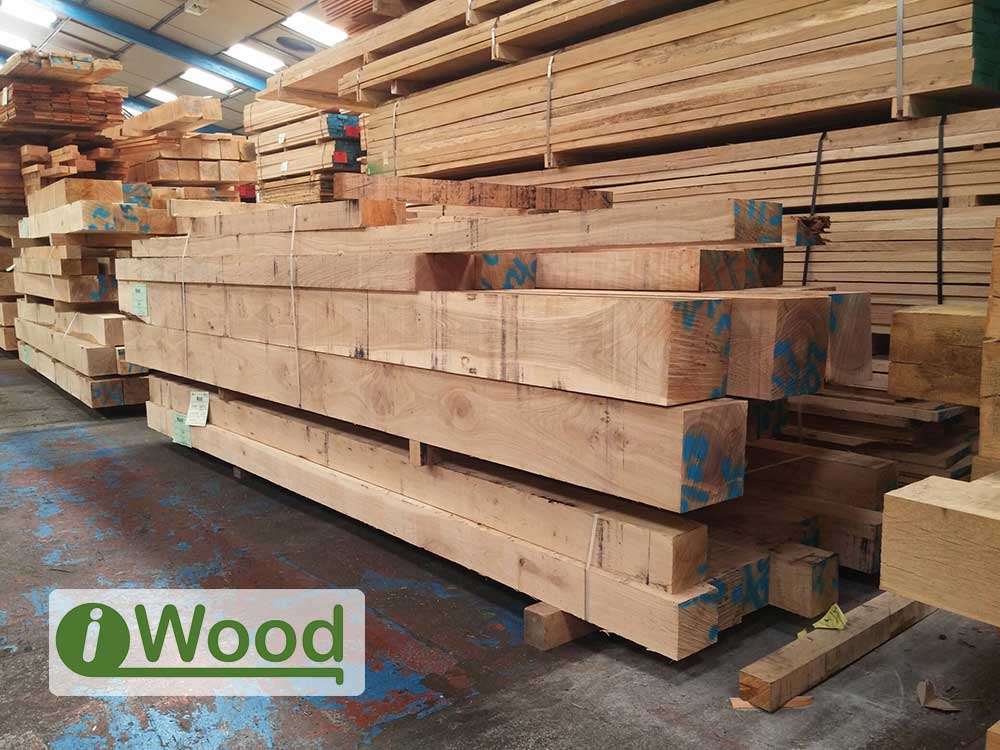
As you can see on some of the photographs, beams can sometimes have black or dark blue marks on them that are picked up during production when they come into contact with ferrous metals. These will fade with time, but they can be removed with Oxalic Acid.
The staining won't harm the beams because it is just the surface reaction, however, if you are putting the beams in constant contact with metal, then to metal needs to be stainless steel to protect the wood. This includes any kind of bracket, screws, nails or rods.
What is the difference between QPA and QP1 Oak?
QPA is the higher grade which reaches D30 while QP1 reaches D24. The main visual differences are that QPA will contain less knots and wane while having no brown streaks, black holes or brown pith. Neither will contain any rot.
How much does an Oak Beam weigh?
Oak is a very heavy material, as a general rule of thumb fresh sawn oak weighs approximately 1200kg/m3 a 150mm x 150mm x 2.5m piece will be approximately 67.5kg.
If there is anything else we can help with please get in touch and our dedicated team will be happy to help.
Call Us: 01889 597 281
Email: enquiries@iwood.co.uk
Chat to us: Use our chat service in the bottom right of your screen to talk to a real person everytime.
Image Gallery
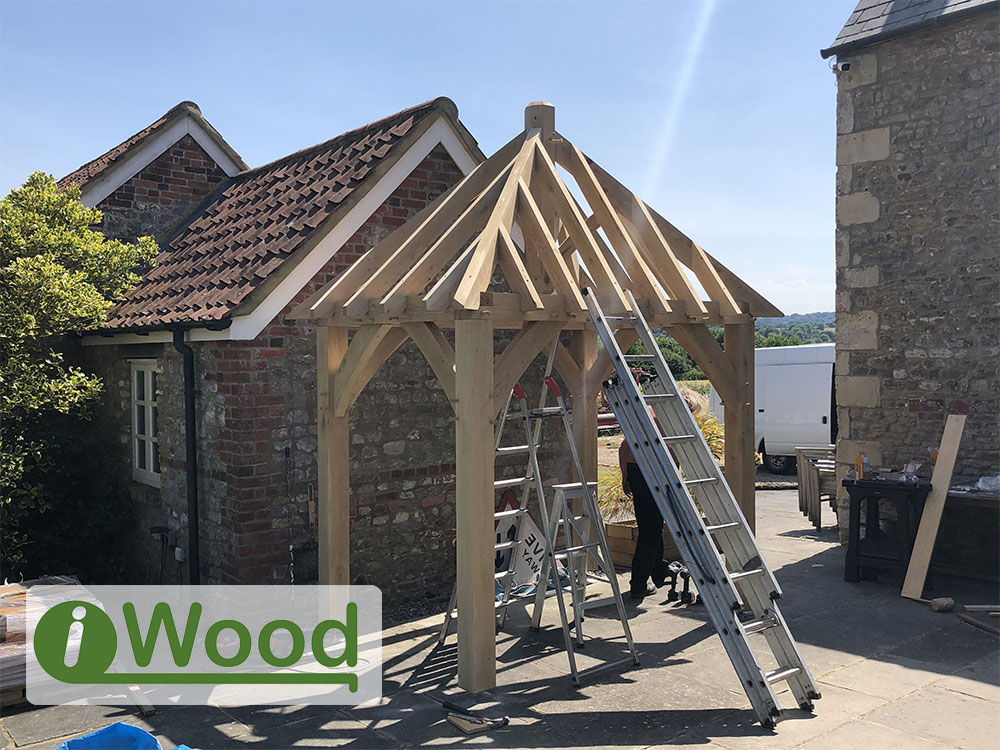
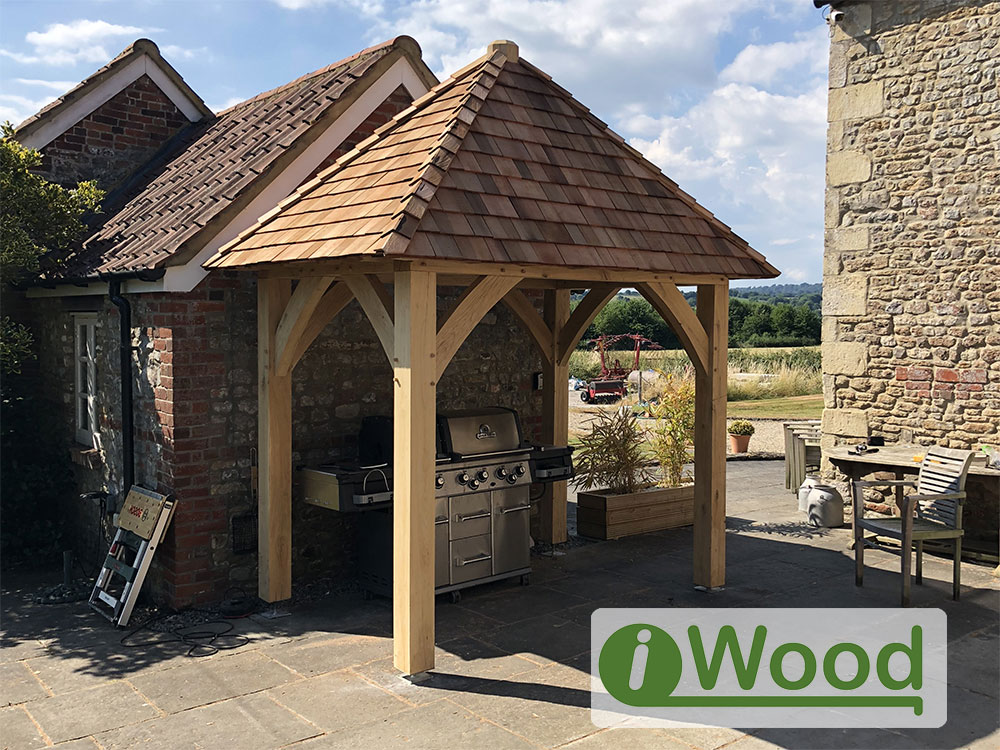
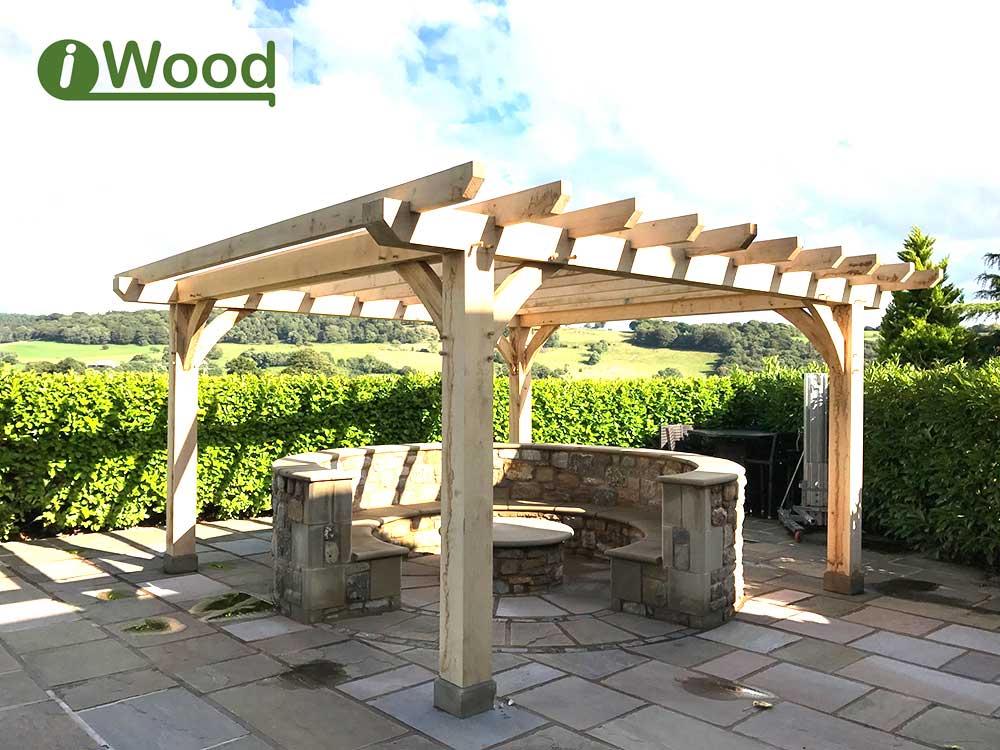
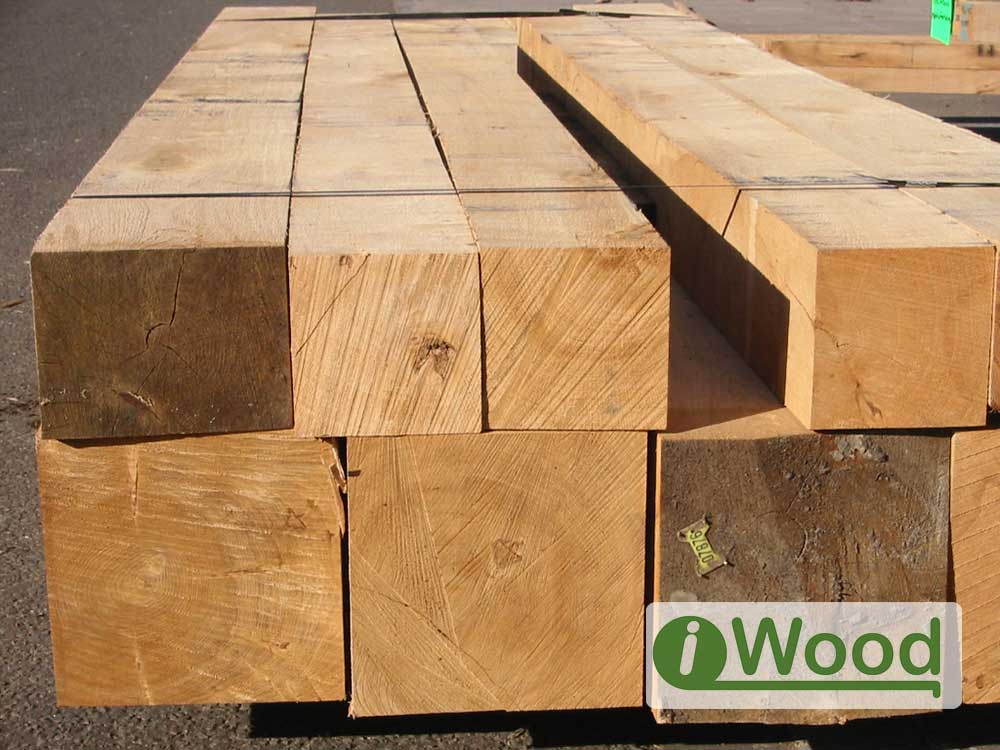
Here are some photographs of beam jobs we've completed recently to give you an idea of the product
| Grade | Available Thickness | Available Width | Available Lengths | Comparison Prices (ex VAT) |
|---|---|---|---|---|
QP1 Fresh Sawn Construct. (D24 Equiv.) | Min: 50mm | Min: 100mm | Min: 1.2m | 100mm x 100mm x 2m (Sawn): £23.11 100mm x 100mm x 2m (Planed): £32.88 140mm x 140mm x 4m (Planed): £124.76 150mm x 150mm x 4m (Sawn): £104.01 190mm x 190mm x 4m (Planed): £224.84 200mm x 200mm x 4m (Sawn): £184.90 240mm x 240mm x 4m (Planed): £354.18 250mm x 250mm x 4m (Sawn): £288.91 290mm x 290mm x 4m (Planed): £534.57 300mm x 300mm x 4m (Sawn): £438.40 |
Air Dried Constructional (EX QP1) | Min: 50mm | Min: 50mm | Min: 2m | 100mm x 100mm x 2m (Sawn): £31.19 100mm x 100mm x 2m (Planed): £79.03 140mm x 140mm x 4m (Planed): £210.75 150mm x 150mm x 4m (Sawn): £164.91 190mm x 190mm x 4m (Planed): £374.66 200mm x 200mm x 4m (Sawn): £293.17 240mm x 240mm x 4m (Planed): £585.41 250mm x 250mm x 4m (Sawn): £458.07 290mm x 290mm x 4m (Planed): £870.94 300mm x 300mm x 4m (Sawn): £687.57 |
QPA Fresh Sawn Construct. (D30 Equiv.) | Min: 50mm | Min: 100mm | Min: 1.2m | 100mm x 100mm x 2m (Sawn): £31.79 100mm x 100mm x 2m (Planed): £42.88 140mm x 140mm x 4m (Planed): £162.68 150mm x 150mm x 4m (Sawn): £143.05 190mm x 190mm x 4m (Planed): £293.19 200mm x 200mm x 4m (Sawn): £254.31 240mm x 240mm x 4m (Planed): £461.85 250mm x 250mm x 4m (Sawn): £397.36 290mm x 290mm x 4m (Planed): £695.74 300mm x 300mm x 4m (Sawn): £600.00 |
Lengths over 4m must have a width and thickness of 100mm or more.